
Plant Care Guide
How to Read Soil Moisture Before Leaves Droop
Learn how to interpret a moisture reading alongside pot size, plant type, season, and recent watering—before reaching for the watering can again.
In this guide
Quick answer
Read a soil-moisture meter as one piece of evidence, not a command to water. Check at a consistent depth in the active root zone, confirm the probe has firm contact with the potting mix, and compare the result with pot weight, soil feel, drainage, and the plant’s recent pattern. A low or high reading means little without knowing the plant, container, substrate, room conditions, and season. When a value surprises you, re-check before changing the watering routine.
What a moisture reading can—and cannot—tell you
Device reading: a soil-moisture meter reports the condition around its sensing area at that place and moment. It can help you compare the same pot over time, notice whether the root zone is trending drier, and check below a surface that may look dry. It does not know the species, the plant’s growth stage, the condition of every root, or whether the entire pot has the same amount of water.
General plant-care guidance: watering needs vary. Illinois Extension lists plant type, temperature, humidity, light, pot size, plant size, potting mix, and drainage among the factors that affect watering frequency. Virginia Cooperative Extension likewise advises monitoring instead of following a rigid calendar. A meter is useful when it becomes part of that monitoring routine.
The number is therefore best used as a comparison, not a verdict. Learn what the reading looks like in a particular pot after it has drained, as it gradually dries, and when other checks indicate that the plant is ready for water. Keep the plant’s reputable care guidance in view. A fern, cactus, young transplant, and mature foliage plant should not be assigned the same target merely because they share a display.
Why the same reading can mean different things
General plant-care guidance: potting mixes store water and air differently. Fine or fibrous ingredients tend to retain more water, while coarser ingredients tend to drain more freely. A chunky mix may leave air gaps around a probe. An old, compacted mix may stay wet longer. A mix that has become difficult to re-wet can contain a damp pocket beside a dry one. Even within one container, the surface, center, sides, and bottom do not dry at the same rate.
Container size and drainage design also change the context. A small pot holds less potting mix than a large one, while an outer pot can conceal drainage water around the inner nursery pot. Roots may fill one area densely and leave another area relatively empty. A reading near the rim may describe a different moisture pocket from a reading in the active root zone.
Light, temperature, humidity, airflow, and season can all change the context. Virginia Cooperative Extension notes that wind can dry the moisture boundary layer at leaves and influence transpiration in container plants. Indoors, a nearby fan, vent, or draft is therefore worth recording when a pot’s usual pattern changes, but it does not establish a fixed drying rate. Warmer or brighter conditions can speed drying; cooler or more humid conditions may slow it. Plant growth also changes through the year. The practical question is not “What number means water for every plant?” but “Is this pot drier than its own well-observed baseline, and do the other signs agree?”
Soluble salts deserve caution too. Maryland Extension explains that fertilizer and water minerals can accumulate in potting media and interfere with root water uptake. Oregon State notes that salinity and other soil properties can affect some sensor readings. A crust on the soil or pot, an unexpected reading, and stressed foliage together justify a broader check; they do not prove one cause.
Check before you water
VODESON editorial recommendation: use the same short sequence each time. Consistency makes changes easier to interpret and helps prevent one surprising number from driving the decision.
- Name the plant and its normal care range. Start with species-appropriate guidance from a reputable source. Note whether the plant generally prefers a more even moisture supply or a longer dry-down.
- Review what changed. Consider the last watering, recent repotting, a move closer to a window, heating or air-conditioning, seasonal growth, and any water left in a saucer or outer pot.
- Lift the pot when it is safe. Compare its weight with the same pot after watering and draining. University of Maryland Extension recommends pot weight as a useful second check because a drier medium weighs less.
- Look and feel. Check the surface, drainage holes, saucer, and accessible potting mix. A dry surface does not establish that the root zone is dry; standing drainage water does not establish that the whole root ball is evenly wet.
- Place the probe consistently. Follow the current product instructions and put the sensing area in representative, evenly packed soil within the root zone. Ensure the mix contacts the probe rather than leaving a visible gap.
- Read, then confirm. Record the value and location. If the pot is large, mixed, or unexpectedly uneven, make a second careful check in a comparable location. Avoid repeatedly probing close to the stem.
- Make the decision from the pattern. Water when the plant’s care guidance, the root-zone reading, pot weight, soil observation, and recent conditions point in the same direction. When they conflict, pause and investigate.
When a reading seems wrong
A surprising value is useful information about the check, even when it is not useful information about the whole pot. Remove the probe gently and inspect the location. Was the sensing area beside the container wall or in a coarse air pocket? Was the soil loose around it? Reinsert according to the linked current product instructions in a nearby representative spot with evenly packed soil and good contact.
Next, test consistency. Compare the reading with soil feel at an accessible depth and with pot weight. If you have recently watered, check whether water drained freely and whether parts of the root ball may still be dry. Virginia Cooperative Extension notes that potting media can become unevenly wet and may need slow, repeated applications to rehydrate. Do not interpret one wet pocket as proof that the full root zone is wet.
If mineral crust is visible or readings remain implausible, consult the current published device-care instructions and the plant’s care source before acting. Repeating the check with the same placement method is more informative than chasing a preferred number in several unrelated spots.
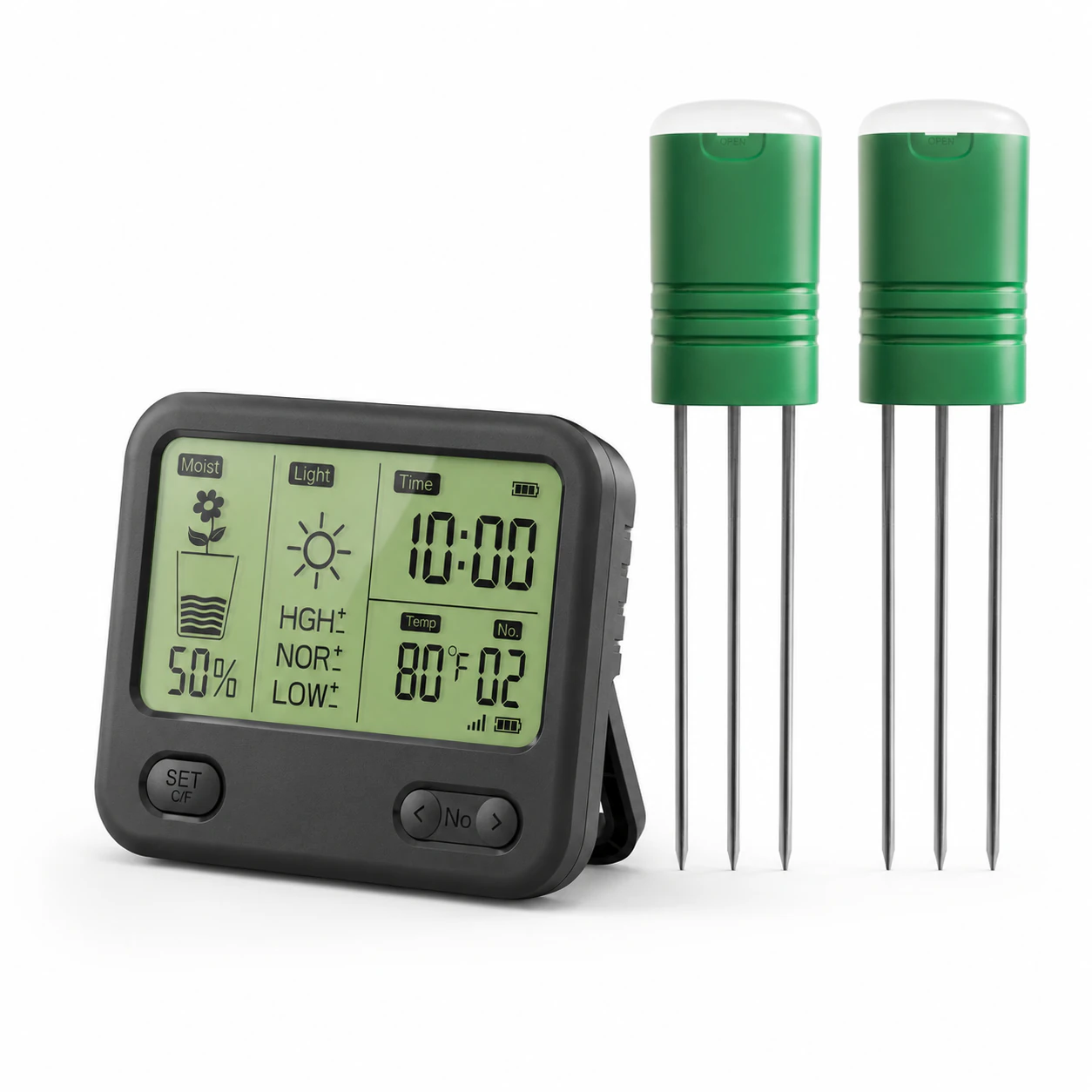
VODESON tool note: the VODESON Soil Detection Kit includes one display and two wireless sensors. Its readings support comparison; they do not replace the plant and pot checks above.
Match the reading with what you see
Plant symptoms overlap. Iowa State Extension explains that wilting can follow either insufficient water or soil that has stayed too wet. Use the table as an observation aid, not as a diagnosis.
| What you notice | Soil and pot check | What the combination suggests | Practical next step |
|---|---|---|---|
| Leaves droop and the reading is lower than this pot’s usual range | The root zone feels dry and the pot is light. | The observations are consistent with a dry root zone, but the plant’s own care needs still control the decision. | If appropriate for the species, water the root ball thoroughly, let excess drain, and note the after-watering baseline. |
| Leaves droop while the reading remains high | The pot is heavy or the medium remains wet; drainage may be slow. | Wilting alone does not justify adding water. Persistently wet conditions can also be associated with wilt. | Pause watering, empty retained drainage water, inspect drainage and the root-zone condition, and seek species-specific help if decline continues. |
| Leaves yellow or drop | Compare several days of readings, pot weight, drainage, light, temperature, and recent changes. | The symptom is nonspecific. A single moisture reading cannot identify its cause. | Correct an obvious care mismatch, document the response, and use a qualified diagnostic service when symptoms persist or spread. |
| The meter reads dry but the pot feels heavy | Accessible mix feels cool or damp, or the probe sat in a coarse gap. | The reading may represent poor contact or one dry pocket rather than the full root zone. | Reposition carefully with firm soil contact and compare a second representative location before watering. |
| The meter reads wet but the pot feels light | The mix has pulled from the sides, or one damp pocket surrounds the probe. | Moisture may be distributed unevenly. | Inspect more of the root zone. If the plant needs water, apply it slowly and confirm that the medium rehydrates and drains. |
| Brown edges appear with mineral crust | Check watering history, fertilizer use, water source, humidity, and drainage as well as moisture. | Salt accumulation is one possible factor, but the symptom and meter value do not establish a diagnosis. | Use Extension guidance for salt management and obtain plant-specific advice before making a major treatment change. |
What to do next
- Choose one priority pot and write down the plant, substrate, container, and usual location.
- Record the meter location, reading, pot weight impression, and soil feel before the next watering.
- After watering and full drainage, record the same observations to create that pot’s comparison point.
- Repeat at a consistent check time while noting major changes in light, airflow, temperature, or season.
- If the signals conflict, re-check placement and contact before adding water.
- If symptoms continue despite a coherent watering routine, consult a local Extension office or qualified plant-diagnostic service.
Sources and method
This guide separates three evidence types. General plant-care guidance comes from university Extension publications. A device reading is treated as a local measurement that depends on placement and conditions. A VODESON editorial recommendation is a conservative routine assembled from those sources; it is not a universal watering threshold.
- General plant-care guidance: Virginia Cooperative Extension, “Properly Watering Container Houseplants” — potting media, uneven wetting, monitoring, seasonal conditions, and overlapping symptoms.
- General plant-care guidance: Illinois Extension, “Watering | Houseplants” — factors that change watering frequency and the limits of meter-only decisions.
- General plant-care guidance: University of Maryland Extension, “Watering Indoor Plants” — pot-weight checks, potting-medium observations, and soluble salts.
- General plant-care guidance: Virginia Cooperative Extension, “Measuring Nursery Plant Water Use in Containers” — how airflow can influence transpiration in container plants and why the effect remains condition-dependent.
- General plant-care guidance: Iowa State University Extension, “Why is my houseplant wilting?” — why wilt can accompany either dry or persistently wet soil.
- Sensor-interpretation guidance: Oregon State University Extension, “Soil moisture monitoring to support irrigation scheduling” — sensor contact, placement, root-zone depth, calibration, substrate variability, and corroborating observations.
- Product reference: VODESON Soil Detection Kit — 1 Display + 2 Sensors and the current VODESON model listing/instructions — product identity, configuration, reading role, and insertion cautions only.
Sources were accessed on August 26, 2026.